Memory Boost Worksheets: Printable & Digital Recall Drills
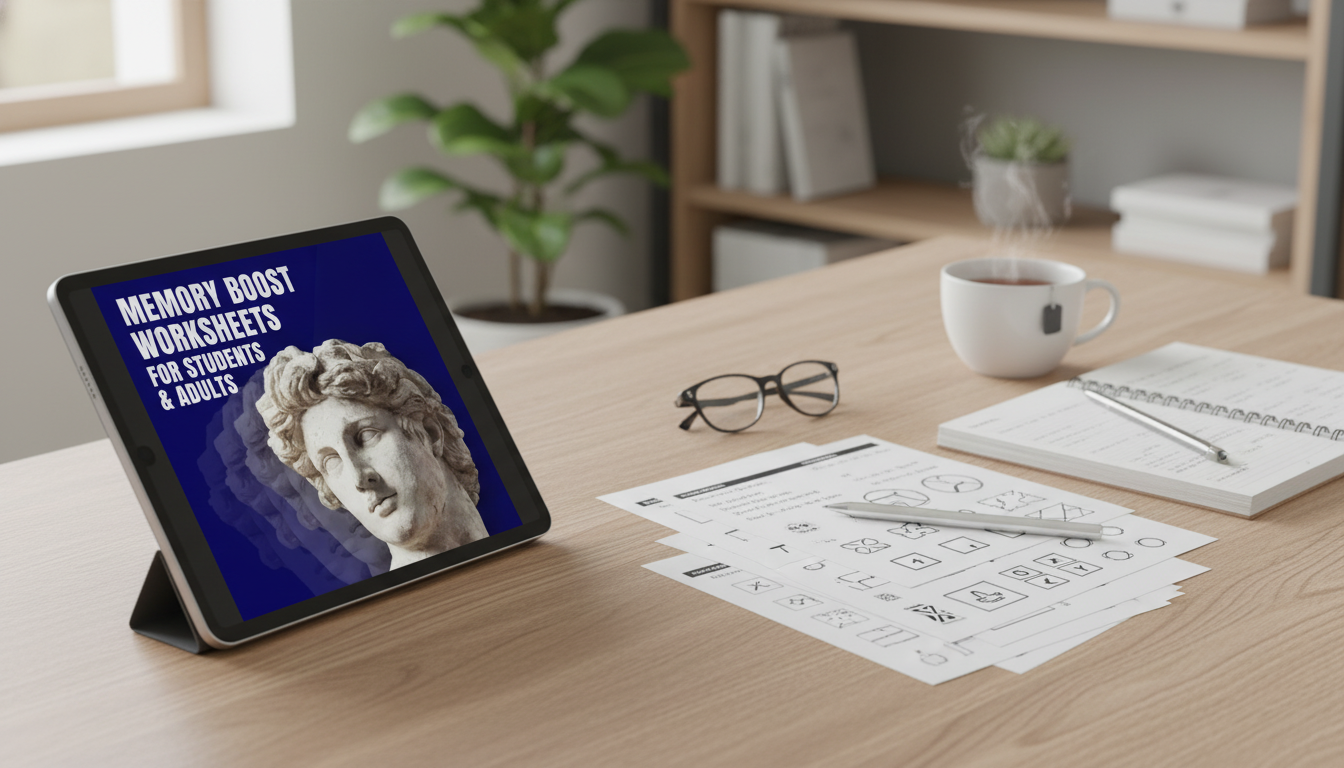
Memory Boost Worksheets for Students & Adults: Printable and Digital Practice for Better Recall
Remembering names, facts, formulas, and key details gets easier with structured practice. Memory Boost Worksheets are designed for students and adults who want repeatable exercises that turn study time into active recall, build stronger retrieval habits, and make learning stick—whether used on paper or as a digital download.
Research consistently shows that “practice testing” (retrieval practice) and spaced review outperform passive rereading for long-term learning. For a deeper look, see findings on retrieval practice in PNAS and the broader review of effective learning techniques (including spaced practice and practice testing) in Psychological Science in the Public Interest.
Who these worksheets help most
- Students preparing for quizzes, exams, and language learning who need stronger recall under time pressure
- Adults balancing work, certifications, and daily tasks who want simple routines to reduce forgetfulness
- Homeschool families and tutors looking for ready-to-use activities that encourage independent practice
- Anyone who prefers guided prompts over open-ended journaling when building study habits
What’s inside the Memory Boost Worksheets set
- A structured collection of brain-training pages designed for repeat practice
- Exercises that support attention, encoding, and retrieval so information is easier to access later
- Memory technique prompts that help convert notes into memorable cues
- Flexible use: print pages for handwriting practice or use digitally for repeatable sessions
If you want a ready-to-go routine (instead of reinventing your study method each week), start with Memory Boost Worksheets for Students & Adults and repeat the same core pages until recall becomes faster and more reliable.
Skills these activities strengthen
- Working memory for holding and manipulating small pieces of information (steps, sequences, short lists)
- Long-term recall for facts and concepts through spaced review and retrieval practice
- Focus and selective attention by reducing passive rereading and replacing it with active tasks
- Study-to-test transfer by practicing the same type of remembering required in real assessments
Printable vs. digital: choosing the best format for your routine
- Printable practice supports handwriting, reduced screen time, and easy annotation with pens/highlighters
- Digital use supports quick duplication, consistent layouts, and portability across devices
- A blended approach often works best: print core tracking sheets and complete drills digitally
Format comparison for different study settings
| Use case | Printable worksheets | Digital worksheets |
|---|---|---|
| Exam prep sessions | Fast marking, easy spread-out pages | Quick resets and repeat drills |
| Daily 10-minute practice | Simple habit stacking with a visible binder | Portable routine on phone/tablet |
| Tutoring or classroom support | Handouts and guided work | Shareable templates for remote sessions |
| Progress tracking | Physical checklists and notes | Duplicate trackers without reprinting |
How to use the worksheets for steady improvement
- Start small: choose 1–2 pages and repeat them several times per week rather than doing everything once.
- Pair each session with a single topic: one vocabulary set, one chapter summary, one formula group, or one set of client details to avoid overload.
- Use timed recall: short time limits encourage real retrieval instead of searching notes.
- Review errors with a simple rule: rewrite the cue, attempt recall again, then schedule a later retest.
Keep sessions short enough that consistency is easy. Ten focused minutes of closed-note recall repeated across a week typically beats one long “study day” filled with passive reviewing. And don’t forget recovery: sleep supports memory consolidation, as summarized by the National Institute of Neurological Disorders and Stroke.
Memory techniques to pair with the exercises
- Chunking: group items into meaningful sets (3–5 pieces) before attempting recall.
- Visualization: attach an image to a term or concept to create a stronger retrieval path.
- Association chains: link each new item to the previous one to remember sequences.
- Method of loci: place items along an imagined route when memorizing ordered information.
- Teach-back: explain the concept out loud in simple terms, then test recall without notes.
A practical way to combine these: use the worksheet prompt to generate a cue (a keyword, picture, or “place” on your memory route), then test yourself later using only the cue—no peeking at the original notes.
Common obstacles and quick fixes
- “It feels easy while studying but disappears later”: switch from rereading to closed-note recall prompts.
- “I freeze on tests”: practice low-stakes timed drills to build retrieval confidence.
- “I don’t know what to review”: track misses and recycle only the hardest items the next day.
- “I get bored quickly”: alternate between two exercise types to maintain engagement without losing consistency.
Product details and how to get started
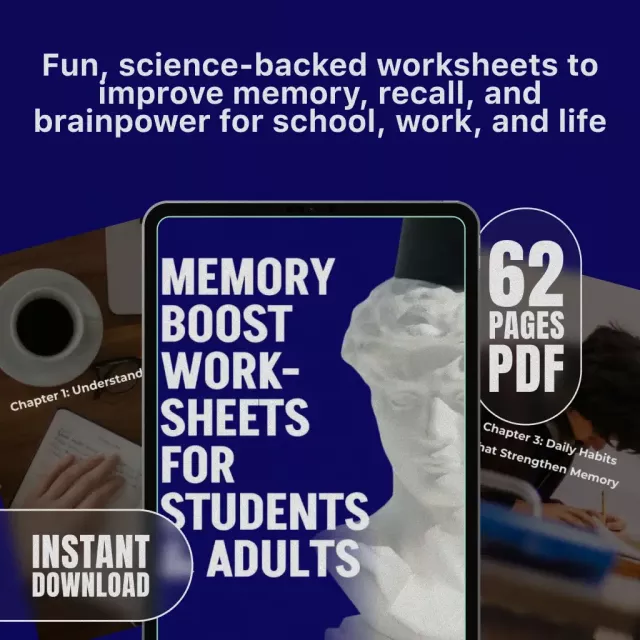
Memory Boost Worksheets for Students & Adults is available as a printable digital download designed for repeated use. It works well for independent study, tutoring sessions, and ongoing brain-training routines.
A simple starting plan:
- 10–15 minutes per day
- 4 days per week
- One weekly review session to retest missed items
For distraction-reduction during study blocks—especially if hair falls forward while reading or writing—consider a simple comfort accessory like the Spring Plaid Wide Padded Headband or the Retro Corduroy Hair Scrunchies & Headbands to keep your setup tidy and consistent.
FAQ
How often should the worksheets be used to see results?
Aim for 10–15 minutes per session, 3–5 days per week, with repeated practice on the same pages. Track what you miss and retest those items after a short delay (next day, then later in the week) to build durable recall.
Are these worksheets better for students or adults?
They work for both because the core skill is retrieval: pulling information from memory on demand. Students can use them for vocabulary, history facts, and formulas, while adults can apply the same routines to certifications, job training, client details, and everyday remembering.
Can the digital download be used without printing?
Yes—digital-only use is completely workable on a tablet, laptop, or phone using a note-taking or PDF annotation app. Printing can still be helpful if handwriting improves focus and retention for you.















Leave a comment