4-Gauge Motorcycle Carb Sync Kit: Hoses & Case
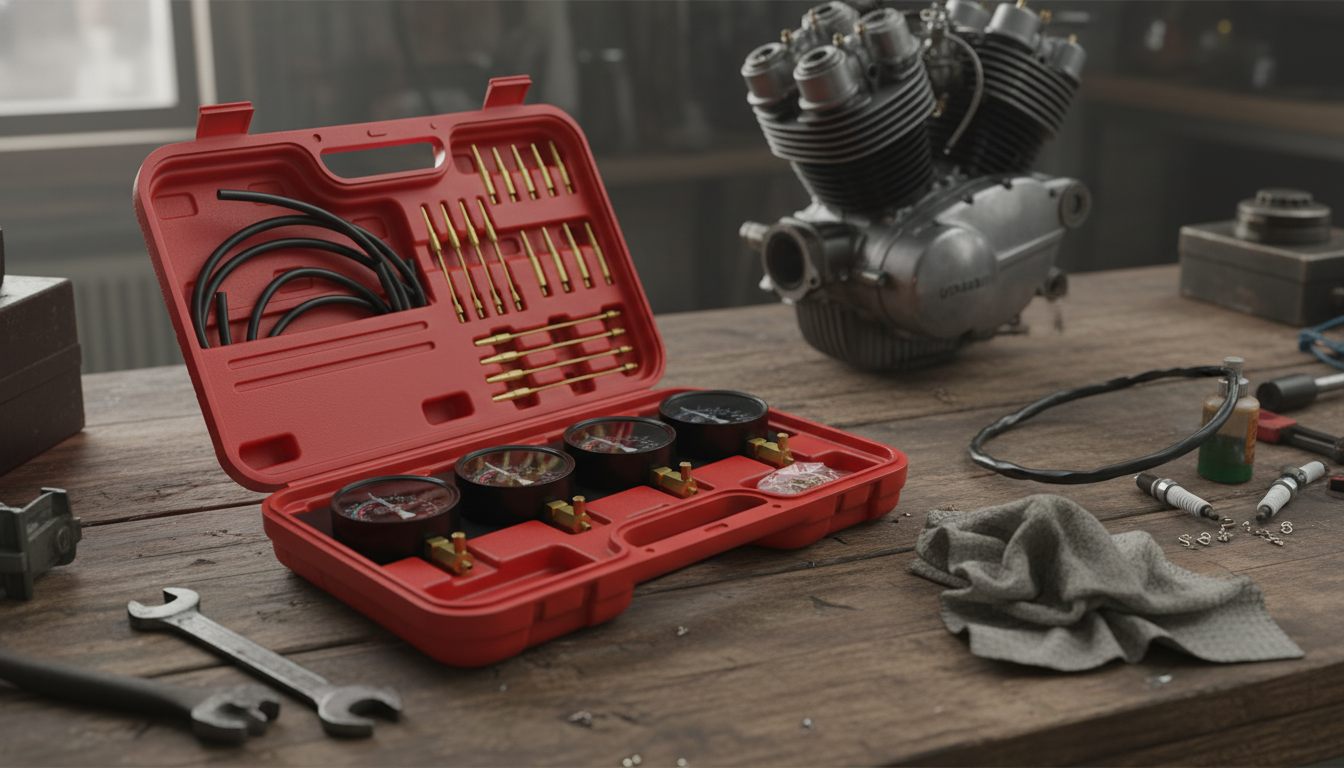
Motorcycle Carburetor Synchronizer Vacuum Gauge 4-Tool Kit with Hoses & Case
Smooth idle, crisp throttle response, and reduced vibration often come down to one adjustment: balancing intake vacuum across cylinders. A multi-gauge carburetor synchronizer makes it possible to compare cylinders at the same moment, then fine-tune the sync screws until the readings match within spec. The Motorcycle Carburetor Synchronizer Vacuum Gauge 4-Tool Kit with Hoses & Case is built for common multi-carb motorcycles and comes with hoses plus a storage case, making it easy to repeat the process whenever the bike’s tune drifts. For more guidance, see Throttle body sync | Yamaha FZ-09 Forum.
What a carburetor synchronizer does (and when it’s worth using)
A carb sync tool reads intake vacuum at each cylinder so you can balance carburetors (or throttle plates on some setups) to the same workload at idle and low throttle openings. When one cylinder is doing more work than the others, the engine often feels “busy” and rough even if it’s otherwise healthy. For further reading, see Carb Synchronizer Tool? – Concours Owners Group Forum.
- Shows vacuum differences between cylinders so carburetors/throttle plates can be balanced to the same load at idle and low throttle openings.
- Typical signs a sync is needed: lumpy idle, hanging idle, uneven exhaust pulses, vibration at steady cruise, poor low-speed manners, and difficulty setting a stable idle mixture.
- Best timing: after valve clearance checks, after carb cleaning/rebuild, after intake boot replacement, or when a bike has sat long enough for settings to drift.
- A sync tool complements—rather than replaces—baseline mechanical work (valves, compression, ignition health, air leaks).
If you want a deeper refresher on how carburetors meter air and fuel, this overview is a solid reference: Carburetor (Wikipedia). For a rider-focused walkthrough, see How to Sync Motorcycle Carburetors (RevZilla Common Tread).
Kit highlights and what’s included
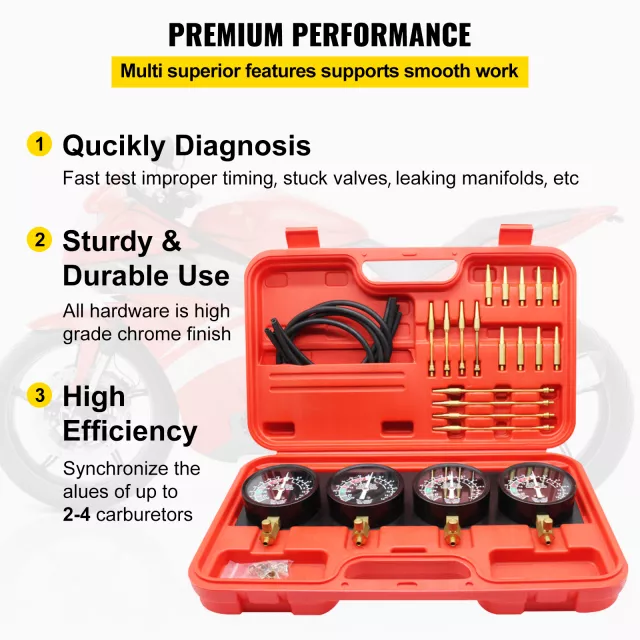
Four gauges let you see all cylinders at once, which is the big advantage over swapping a single gauge from port to port. Inline-fours and V4s are the obvious match, but the kit can still be used on twins and triples by leaving unused gauges disconnected and capping any open vacuum ports on the bike.
- Four vacuum gauges allow simultaneous comparison on up to four cylinders—helpful for inline-fours and V4s, and still usable on twins/triples by capping unused lines.
- Hoses and fittings help connect to intake vacuum ports or adapter points on the intake boots/manifolds.
- Portable case keeps gauges protected and hoses organized between tune-ups.
Typical in-box components and their use
| Component | What it’s for | Setup tip |
|---|---|---|
| 4 vacuum gauges | Compare cylinder vacuum simultaneously | Hang or prop the panel level for consistent readings |
| Hoses | Connect each gauge to each intake vacuum source | Use equal-length routing when possible; avoid sharp kinks |
| Adapters/fittings (varies by kit) | Match different vacuum port sizes/styles | Confirm thread/fit before tightening; don’t overtighten into soft boots |
| Storage case | Protect gauges, prevent needle damage | Store dry and clean; keep hoses loosely coiled |
Before starting: preparation checklist
Synchronization is a “fine adjustment,” so it pays to remove the big variables first. A perfectly synced rack won’t cover for tight valves or a vacuum leak.
- Warm the engine fully to operating temperature; a cold sync can drift after warming.
- Check basics first: fresh fuel, clean air filter, no intake leaks, and correct spark plugs/ignition condition.
- Verify valve clearances are within spec; tight valves can mimic sync issues.
- Ensure the bike is stable: center stand or a secure paddock stand; keep the work area ventilated.
- Locate vacuum ports (often capped nipples on intake boots/manifolds, or dedicated sync ports). Have caps ready for reinstallation.
How to connect the gauges (leak-free and readable)
Most “mystery readings” during syncing come from tiny air leaks at the hose connections or from pinched routing. Take an extra minute here and the adjustment phase becomes straightforward.
Step-by-step synchronization process (4-cylinder friendly)
Interpreting readings: what “off” looks like
Common gauge patterns and what to check
| Gauge behavior | Likely cause | Next check |
|---|---|---|
| One cylinder much lower vacuum | That cylinder flowing more air or has an intake leak | Inspect boot/manifold seal; confirm sync screw order |
| One cylinder much higher vacuum | That cylinder more closed than the rest | Adjust the correct sync screw incrementally |
| All equal but unstable needles | Misfire/compression/air leak | Plugs, coils, compression test, leak check |
| All equal but poor idle | Mixture/idle speed/valve issue | Idle mixture settings; valve clearance |
Care, storage, and long-term accuracy
In-stock picks
- Motorcycle Carburetor Synchronizer Vacuum Gauge 4-Tool Kit with Hoses & Case
- Crystal Moon & Star Car Vent Clips
- Spring Plaid Wide Padded Headband – Chic Cotton Blend Hair Accessory
FAQ
Can a 4-gauge synchronizer be used on a 2-cylinder or 3-cylinder motorcycle?
Yes. Connect gauges to the cylinders you have and leave the extra gauge lines unused; make sure any open vacuum ports on the engine are capped so you don’t create a leak. Follow your service manual’s recommended adjustment order for that engine.
Why do the gauge needles bounce or flutter a lot?
Some pulsing is normal because each cylinder draws vacuum in pulses. Excessive flutter can be reduced with restrictors/dampers, but it can also point to an air leak, a misfire, low compression, or a loose hose connection.
Do carburetors need to be synchronized after a carb rebuild or valve adjustment?
Often, yes. Changes to airflow, linkage position, or engine breathing can shift cylinder balance, and synchronizing afterward helps restore a stable idle and smooth low-speed response.















Leave a comment