Passive Income Roadmap: 30-Day Plan to Build Wealth

Build Wealth with Passive Income: A Beginner-Friendly Roadmap from Side Hustle to Systems
Passive income is built, not found. The fastest progress usually comes from choosing one realistic income stream, setting up repeatable systems, and tracking the numbers that matter. The goal isn’t “never work again”—it’s building assets that keep earning while your weekly effort trends down and your reliability trends up.
What Passive Income Really Means (and What It Doesn’t)
Passive income lives on a spectrum. Nearly every “hands-off” income stream requires upfront effort—research, setup, creation, or capital—followed by reduced ongoing time once systems and assets are in place. That’s the trade: concentrated work now to buy back hours later.
Three myths slow beginners down:
- “Set it and forget it.” Even strong assets need maintenance: updates, customer questions, or platform changes.
- “No skills needed.” Skills can be learned quickly, but every model rewards competence—writing, design, marketing, budgeting, or basic tech.
- “Instant results.” Some paths can get a first sale fast, but consistency usually beats speed.
Leverage comes from two levers: systems (processes, automation, templates) and assets (content, products, capital). A healthy target is to reduce active hours over time while improving risk management—diversifying traffic sources, documenting processes, and keeping finances clean.
7 Beginner-Friendly Passive Income Paths (Digital-First Options Included)
- Digital products: templates, checklists, printables, mini-guides—ideal for organized creators who can package repeatable value.
- Affiliate content: helpful reviews and tutorials—best for people who can publish consistently and build trust.
- Online courses/workshops: deeper teaching—best if you have a clear skill and a defined audience problem.
- Licensing: photos, music, designs—best for creators with a portfolio and patience for catalog growth.
- Micro-SaaS/no-code tools: simple software that solves one pain point—best for builders comfortable with iteration.
- Dividend/interest investing: long timeline—best paired with budgeting and automated contributions (review basics at Investor.gov).
- Rental-like models without real estate: equipment rental, storage, or car-sharing—best for owners who can maintain an asset.
Pick the Right Idea: Fit, Demand, and Maintenance
Start with skills + interest + proof of demand, not trends. The most “passive” idea on paper can become exhausting if it requires constant support or relies on unpredictable platforms.
Define a narrow problem:
- Who it helps (a specific type of buyer)
- Outcome it creates (the result they want)
- Time/cost saved (why it’s worth paying for)
Then estimate maintenance realistically: support time, updates, refunds, platform rule changes, and compliance (affiliate disclosures, for example, should follow FTC guidance). If income depends on constant custom work, it’s a side hustle—not yet passive. Finally, choose one primary channel (marketplace, your own site, social, or email) and one backup channel to reduce risk.
Quick idea scorecard (choose one to start)
| Idea | Upfront effort | Cost to start | Time to first sale | Ongoing maintenance | Beginner fit |
|---|---|---|---|---|---|
| Digital checklist/guide | Medium | Low | Short | Low | High |
| Affiliate blog/video | Medium–High | Low | Medium | Medium | Medium |
| Course/workshop | High | Low–Medium | Medium | Medium | Medium |
| Licensing (photos/designs) | Medium | Low | Medium–Long | Low | Medium |
| Dividend/interest investing | Low | Medium | Long | Low | Medium |
A Simple 30-Day Roadmap: From Concept to First Repeatable Sales
- Days 1–3: Choose one idea, define the buyer, and write a one-sentence promise (outcome + timeframe/effort).
- Days 4–7: Validate quickly: search marketplaces, scan forums, read competitor reviews for gaps, and list 10 customer questions.
- Days 8–14: Build a minimum viable asset (MVA): a short guide, template pack, or starter bundle. Keep the scope tight so it ships.
- Days 15–18: Create sales-page basics: clear headline, what’s inside, who it’s for, expected results, simple visuals, FAQs.
- Days 19–22: Set up delivery and automation: file hosting, checkout, confirmation email, and a support inbox template.
- Days 23–26: Launch to a small audience: 3–5 posts, 1 email, 1 limited-time bonus, and a direct request for feedback.
- Days 27–30: Improve conversion: tighten the promise, add examples, simplify steps, and start building a second traffic source.
Money Planning That Makes Passive Income Sustainable
- Track weekly: revenue, expenses, and time spent. Then compute profit per hour to spot what scales.
- Use a reinvestment rule: for example, 20–40% of profit goes into tools, ads, education, or outsourcing.
- Build runway: emergency fund + predictable bills before pushing riskier experiments.
- Plan for taxes and fees: platform fees, payment processors, and tax obligations. For U.S. basics, reference the IRS Self-Employed Tax Center.
Common Sticking Points (and How to Get Unstuck Fast)
Planner & Checklist: Turn Goals Into Weekly Actions
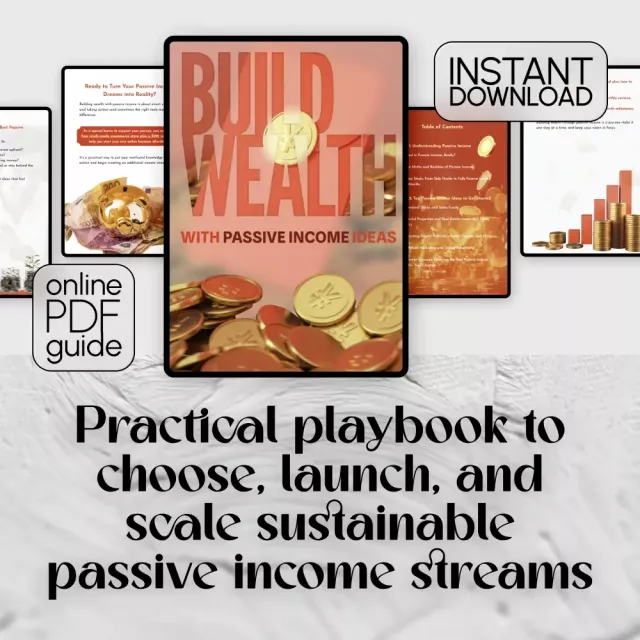
- Build Wealth with Passive Income Ideas | Digital Download PDF eBook | Financial Freedom Roadmap | Side Hustle to Passive Income | Beginner-Friendly Instant Download | Money & Finance Planner & Checklist
- Spring Plaid Wide Padded Headband – Chic Cotton Blend Hair Accessory
- Retro Corduroy Hair Scrunchies & Headbands – Large, Soft & Stylish
FAQ
How much money is needed to start building passive income?
Many digital-first options can start with very little money (often under $50) if you create the product yourself and use a free/low-cost publishing platform. Capital-based options like investing require more runway, but they can still begin with small automated contributions and grow through reinvestment.
How long does it take to earn the first $100 in passive income?
A small digital product can reach the first $100 in days to weeks if it’s validated and shown to an existing audience, while affiliate/content models often take months as traffic compounds. Investing typically takes the longest because returns scale with time and contributed capital.
What’s the difference between a side hustle and passive income?
A side hustle usually trades time for money (custom services, hourly work), while passive income is driven by assets and systems that keep earning with less ongoing time. A common bridge is productizing a service—turning repeated client work into a template, guide, or packaged offer.















Leave a comment